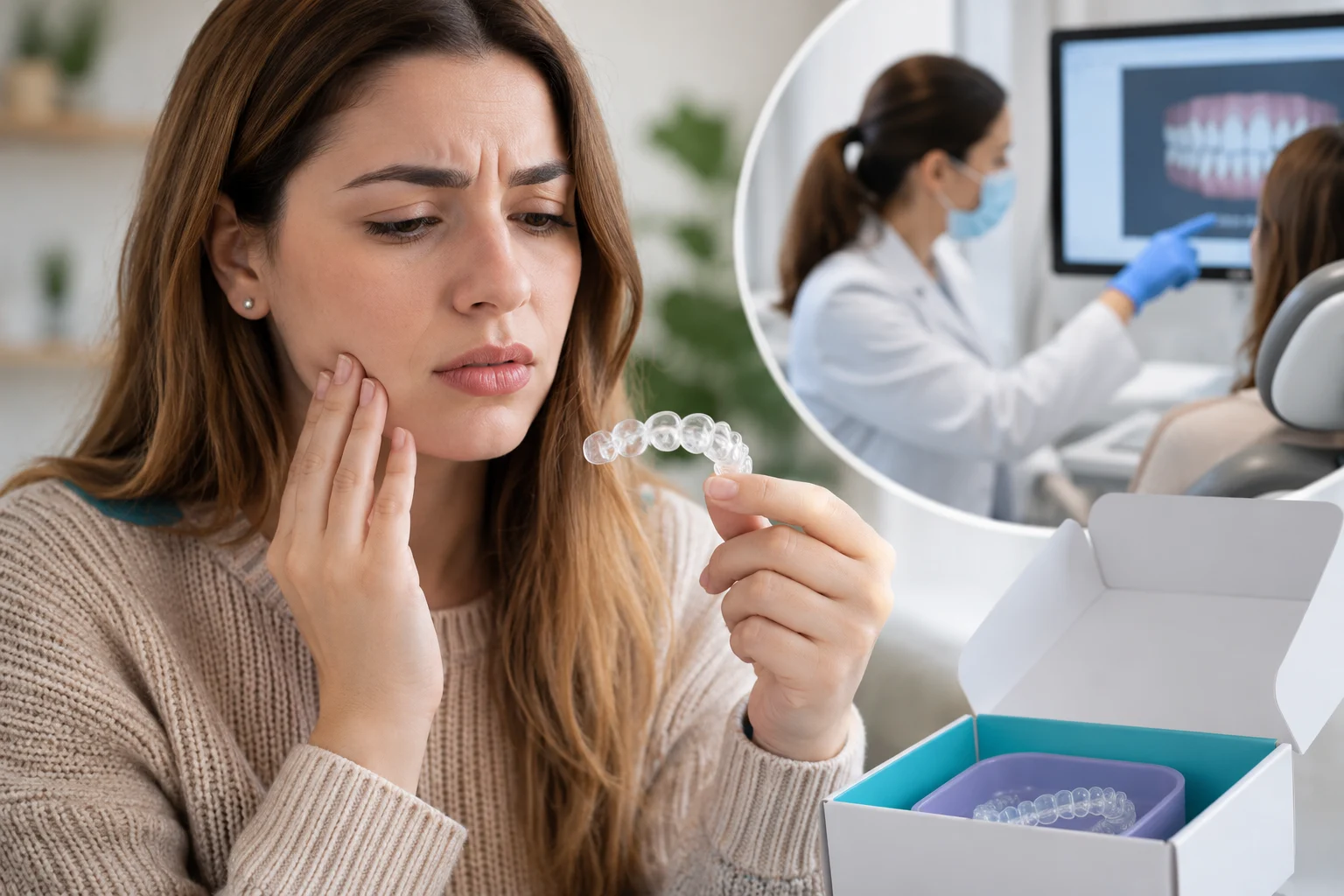
A closer look at at-home aligner kits, what they leave out, and why many dental professionals recommend supervised clear aligner treatment instead.
A quick ad promising straighter teeth from your living room can be tempting, especially if you have been self-conscious about your smile for a long time. The price looks friendly, the process looks easy, and the photos look great. What those ads rarely explain is what is missing compared with treatment guided by an orthodontist.
So, are mail-order aligners safe? It depends on your teeth and gums, but the main risk is that no one examines your mouth in person before your teeth start moving. Moving teeth is a real biological process that changes how your teeth, gums, and bone work together. This guide takes a closer look at at-home aligner kits, what they leave out, and why many dental professionals encourage supervised care instead.
Mail-order aligner programs are completed mostly or entirely at a distance. You usually take impressions with a kit that arrives at your home, or you submit photos or a scan. A treatment plan is created from that information, and a series of plastic aligners is shipped to you. A licensed provider may review your case remotely, but you typically never sit in a chair or have your mouth examined in person.
Supervised clear aligner treatment starts very differently. An orthodontist examines your teeth, gums, and jaw, often takes X-rays, and builds a plan around the whole picture of your oral health. You then return for check-ins so your provider can see how your teeth are responding. It is the same type of appliance with a very different level of care.
When you compare the two approaches, the gaps in mail-order programs become easier to see.
Each of these is a layer of safety that supervised treatment includes as a matter of routine.
According to the American Association of Orthodontists, moving teeth is a medical procedure, and only an in-person evaluation can properly assess whether someone is a candidate for treatment. The Association has also pointed to risks such as loose teeth, damage to tooth roots, bite problems, and jaw joint issues when treatment begins without an exam.
Teeth move through bone, and that process is much more delicate than it looks from the outside. When it is not monitored, several issues may be harder to catch early:
These are possibilities, not certainties. Still, many of them are easier to prevent or manage when a professional is watching your progress in person.
Mild crowding or spacing is often what at-home ads show. Real smiles are less predictable. Bite problems, crowded teeth with limited room, missing teeth, existing dental work, and gum concerns can all change what is safe and realistic. Judging those factors takes an exam, which is part of what an orthodontist can do that a dentist cannot, since orthodontists complete years of additional training focused on tooth movement and jaw alignment.
Treatment guided by an orthodontist is built around you, not just around a set of molds. Here is what that typically involves:
If you are exploring clear aligners in Charlotte, NC, an orthodontic consultation can show you what a thorough evaluation looks like and which options may suit your teeth. If you have never been to one, here is what to expect at your first orthodontist appointment.
Convenience and cost are understandable reasons to look at mail-order programs. But a lower upfront price may not tell the whole story. If your treatment needs to be redone, adjusted, or supported by additional care, the overall experience may look different than you expected. The American Association of Orthodontists has also cautioned that some mail-order payment plans include interest, so the total cost over time deserves a close look.
It can help to think about what is included. Ask whether a licensed provider will examine you in person, whether X-rays are part of the plan, how follow-up and retainers are handled, and who you would contact if a problem came up. Comparing what each option includes gives you a clearer sense of value than comparing price alone, and a look at what clear aligners cost in Charlotte can show what supervised care involves.
Whichever way you are leaning, a few questions can help you feel more informed.
If you ever feel pressured to decide quickly, that is a good time to pause and ask for more information.
Do not wait it out. Persistent pain, aligners that no longer fit, bleeding or swollen gums, or teeth that feel loose are all reasons to stop and have someone look at your mouth in person. Treatment can often be adjusted or paused once a provider can see what is happening, and early attention usually leaves more options open.
The work does not end with the last aligner. Teeth have a natural tendency to shift back over time, which is why retainers are usually recommended. Supervised care typically builds retainer fitting and follow-up into the plan, so someone checks that everything is staying in place. You can read more about life after aligners to see what the retention phase looks like. With remote programs, it is worth asking exactly how this is handled before you begin.
If you have questions about straightening your teeth, you deserve answers from someone who has actually examined your mouth. At Sacksteder Orthodontics, we take time to listen to your goals, evaluate your smile, and explain which options may fit your needs, with no pressure to decide on the spot. Our complimentary consultations are a simple way to start. Whether you are curious about clear aligners in Charlotte, NC, or you want to understand what a proper evaluation involves, we are happy to help. Schedule an orthodontic consultation in Charlotte, NC, and take a confident first step toward the smile you have in mind.
Safety depends on your individual teeth and gums and on the level of oversight. Many dental professionals recommend an in-person exam and imaging before moving teeth, since some problems may not be visible without them.
Supervised treatment includes an in-person exam, imaging, and regular check-ins, while mail-order programs usually do not. An orthodontist can explain what that difference may mean for your case.
Gum disease and untreated decay are generally addressed before tooth movement begins. Without an in-person exam, they may not be identified, which is one reason an evaluation matters.
Pause and schedule an in-person visit. An orthodontist can examine your teeth and gums, discuss what you have experienced, and help you decide what to do next.
A consultation is the best way to find out. Your provider can review your teeth, gums, and bite and explain which options may suit your goals.
Call to book a consultation or send us a message.


